-
 Detroit Art Review: Lakela Brown, Parts and Labor (Eight Collard Green Leaves, Five Hands) 2024, urethane resin.
 -
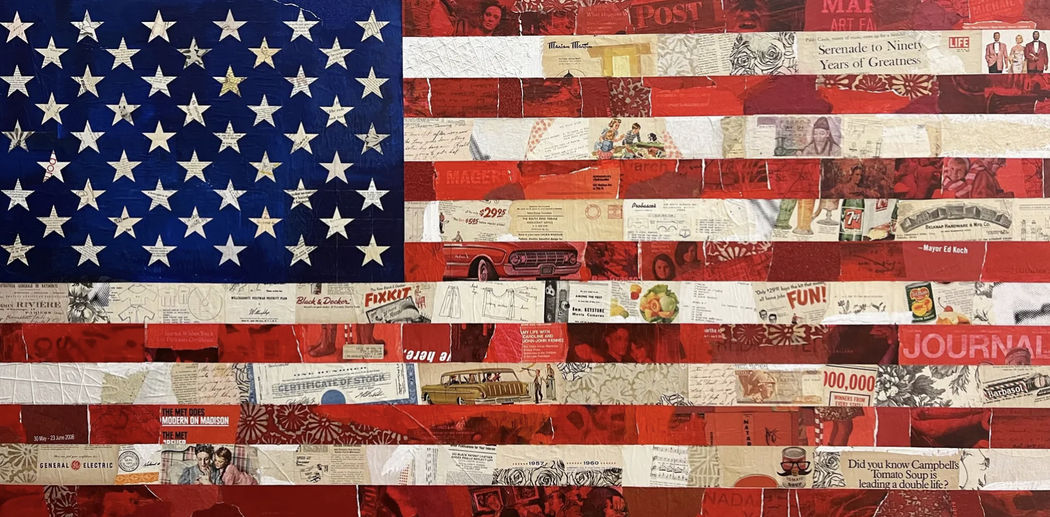 artwork: Cey Adams, 2024
 -

The Dilemma of Identity-Based Exhibitions
by Lucy WhiteThis is our last blog post for 2025. We would like to thank you for your continued interest and support as we build out our permanent home, scheduled to open in 2026. We wish all of you a wonderful New Year filled with health, peace, and beautiful experiences.In December of 2024, Dean Kissick published “The Painted Protest” in Harper’s Magazine, in which he argues that the adoption of identity-based politics within art has led to a shallow aestheticisation of political struggles. In his critique, he claims that artists have not had a meaningful impact or generated innovation in their work, and that, rather than focusing on politics and identity, they should return to exploring human experience. What Kissick argues in his article reveals a larger conversation about the contentious debate over identity politics in contemporary art that has emerged in recent years.
What I find interesting in Kissick’s argument is the convenient exclusion of a wide-ranging art-historical claim: art has always been political. To be apolitical and attempt to show neutrality is itself a political stance. Art is not made in a vacuum; there is no position it can take without political power or context shaping it.
Art allows artists to express themselves, who they are, and their lived experiences. As Georgia O’keef said, “I found I could say things with colour and shapes that I couldn't say any other way—things I had no words for." Identity-based art provides a language for issues and subject matter we don’t yet know how to talk about; it allows artists to explore marginalised, silenced experiences that have been rendered invisible in dominant culture. To ask an artist to withdraw from identity-based art is to ask them to withdraw from themselves.
However, the true dilemma of identity-based exhibitions is when the institutions that host them do not practice the values they publicly endorse. Take The New Museum, for example. The museum was founded on radical alternative values that attempted to break down hierarchies. The New Museum has held numerous exhibitions focused on identity as it relates to broader politics, yet the institution's internal practices stand in stark contradiction to these presented ideals. The New Museum has been accused of fostering a toxic workplace environment, failing to pay its staff, and engaging in union-busting.
In 2019, workers at the museum began organizing and unionizing, which was met with immediate pushback. The institution hired the law firm Proskauer Rose to represent them, where attorney bills were around $1,500 an hour. In November of 2022, the New Museum began reconstruction of its building, for which construction cost $82 million dollars. Throughout these periods, the museum management claimed it did not have the funds to raise employee wages, yet they were prepared to spend exorbitant amounts of money where it benefited them. While the union was ultimately successful, it was not without extraordinary effort and difficulty.This contradiction of the New Museum begs the question: How can an institution present exhibitions about identity, class, labor, race, gender, and sexuality while simultaneously undermining the labor rights of its own workers?
The real dilemma of identity-based exhibitions is not simply that they exist, but that they are often housed and instrumentalized by institutions as symbolic shallow gestures rather than any engagement with critical structural commitments. What could be a site of critical engagement for proactive conversations becomes a spectacle that enhances the institution’s reputation. For large institutions, identity becomes a branding strategy and a form of cultural capital while their employees and the artists remain in substandard positions.
At this moment in our country, authoritarianism is becoming ever more explicit. People are being kidnapped and deported, women are losing access to reproductive healthcare, journalists are being suppressed, and violence is increasing. If there were ever a time for artists to respond to the horrors happening in the world, it would be now. To dismiss the political engagement within art at this very moment helps uphold dominant cultural ideologies and ignores the highly political roots and history of art.
To live in a certain body, to be a woman, to have a certain skin tone, to be queer, to be trans, to be an immigrant, under our current conditions in our current culture is unavoidably a political act. Living in those bodies, the world imposes violence onto these identities. It is not the fault of those who live in these bodies that their existence is politicized; it is the fault of the system that imposes politics onto them. As long as the lived experiences of marginalized people are shaped by inequality and violence, art rooted in identity will not only remain relevant but also necessary.
-
-

-
-
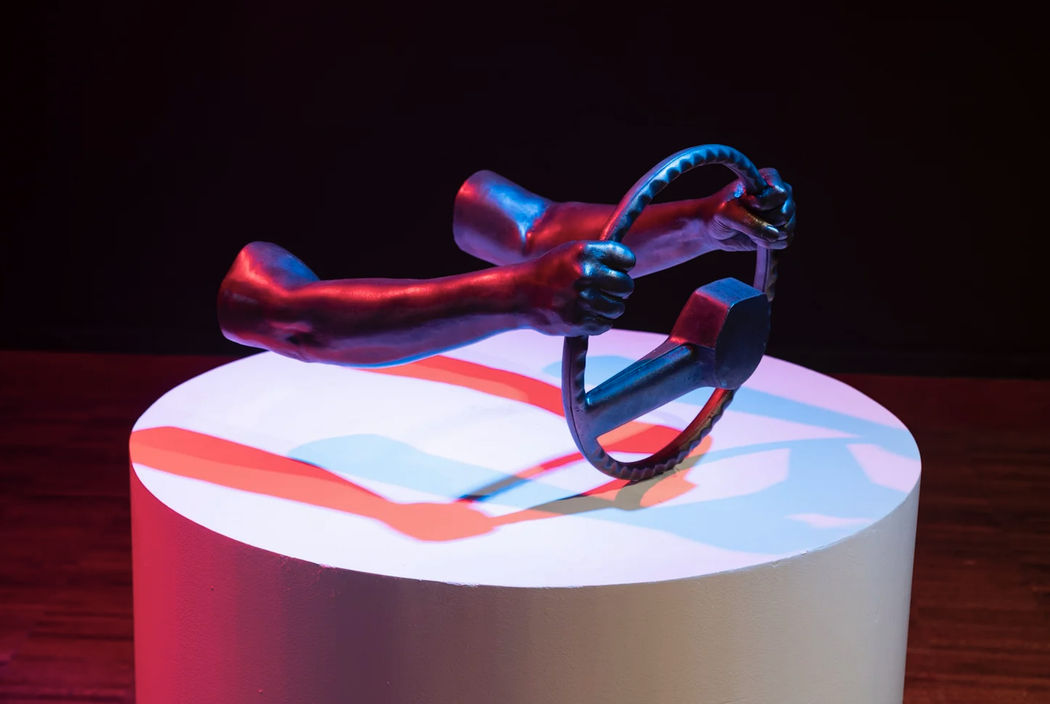 Hands where I can see them. Michael Coppage.
A Spotlight on the Artist Michael Coppage
The Power of Using Art to Confront Race and Representation -
-
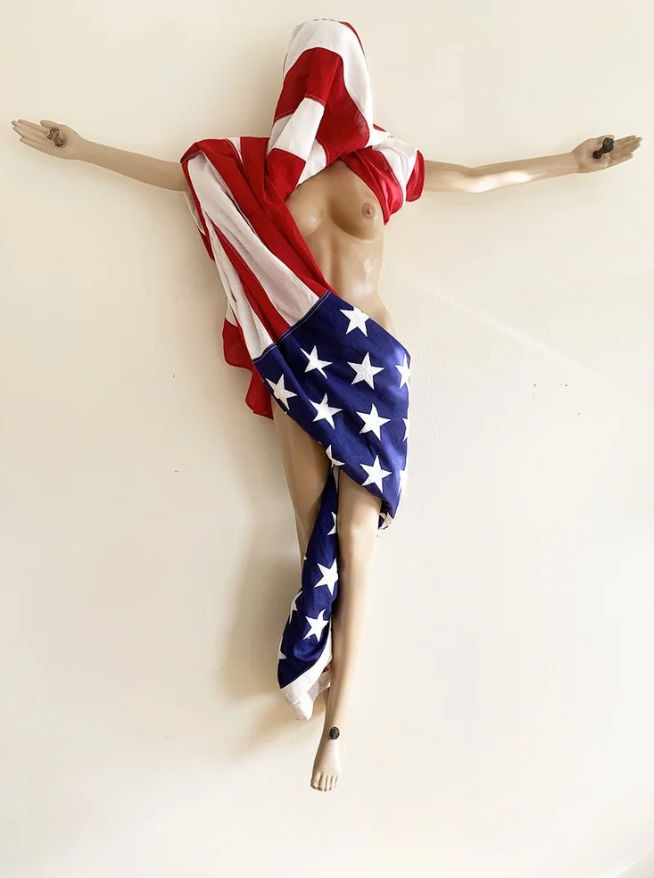 V.L. Cox The Crucifixion of Mary
 -
-
Test Your Knowledge
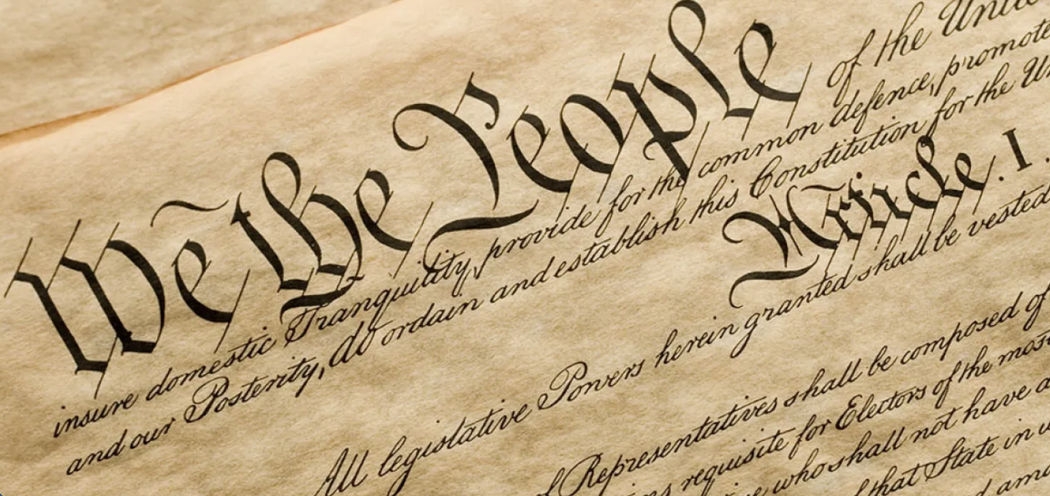
Could you pass the test?As we continue our exhibition, "Stars, Stripes, and Reckoning: Threads of a Nation," and our country continues to endure ongoing ICE raids and divisiveness over who belongs, I would like to challenge you (and myself!) to test your knowledge on history, civics, and American government. The following questions are included on the civics test that individuals must pass to become a U.S. citizen.
Personally, I am uncertain whether I could easily pass this test without a fair amount of studying beforehand. Yet in 2024 alone, the U.S. Citizenship and Immigration Services (USCIS) welcomed 818,500 new citizens. All of whom had to pass a naturalization test, which includes a civics component.
Give it a try and let me know how you do (answers below… don't peek!). I am of the opinion that if others entering our country must know these answers, then perhaps American citizens should too